

ARTEL | Identity of Space | 2016
ARTEL
14th March - 10th April 2016
Residency

‘Identity of Space’ indicates the concordance between the space and its identity. While creating that identity through their engagement with the space, 10 artists from across the world have explored myriad possibilities of art making within the transitional site of Hotel Shalimar.
The simultaneity of the cityscape of Pune as a conundrum of distinct realities and layers of history, and an old hotel space with its architectural elements, abandoned corners and presence of human labour has reflected in the processes and works displayed at TIFA. These projects collapse the boundaries between inside and outside, public and private, permanency and temporality while connecting artists’ personal narratives with narratives of the space. The drawings, videos, photographs and performances capture artists’ interactions with the space that they occupied for a month through visuals, sounds, actions but also through subtleties and silences.
"Dust To Dust" | Aditya Fachrizal Hafiz a.k.a Gooodit
Various Medium

Globalization makes the identity of a place lose its role. The formation of the identity of space cannot be separated by the presence of the actor therein. One of these actors is a creative community like TIFA Working Studios, Pune. The place and the creative community play a crucial role in the formation of the identity of a place where identity is reviewed through the influence of the place of the creative community, or vice versa. The identity of space supports the activities undertaken while creating an interaction between individuals.
Identity is the fundamental thing of our experience of a place as they are inseparable unity. The identity of a place is also defined by the physical setting, activities, and the meaning attributed to such a space. Physical setting refers to the relationship between objects that are placed in the space. This placement of objects through certain human interactions attributes a sense of space to a place.
Starting from the observations that I did, I had the idea to design and create a situation where many people will be mutually interacting with one another to the specific situation. This is an experimentation to question the boundaries and inter-relation between the objects (art) is not a 'product' end of the creative process but seen as a prefix or a medium to trigger an interaction, where the process of experiencing something new is paramount. In this specific situation spectators (the audience) are also performers or actors.
Your daily - It’s our magic | Chiu Chih Hua
Short Film
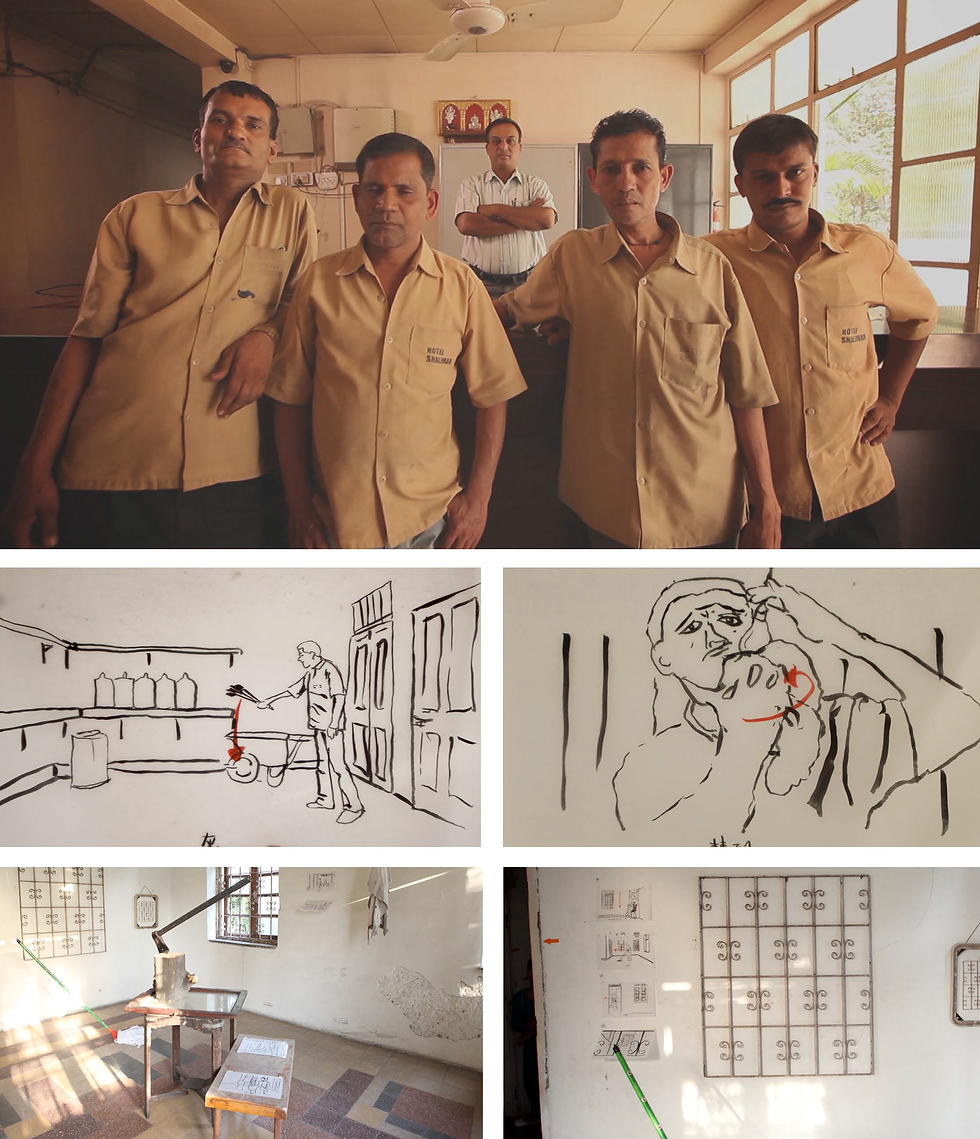
Shalimar Hotel is an old-fashioned but distinctive inn in the city of Pune. The film intends to explore the daily work processes of the staff of Shalimar Hotel. It builds a visual narrative about the daily work by the staff members that includes dusting, washing and cleaning of the hotel but also moments of pause and rest. This daily labor of Shalimar staff occurs within the unique space of the hotel but is also influenced by the particular characteristics of the physical environment. Beginning early in the morning, the work progresses through the day with the changing qualities of sunlight. The film engages with the staff and place by consistently reverting to observations of the physical movement of the body. By stringing together people and space, this film explores daily Indian movements in manual labor, combined with the elements of motion, action and repose.
State Change | Dheer Kaku
Video Installation

While light changes, so does perspective, then there is a change in perception and an urge to state that change.
Room of tables
A museum of meaningless choices, every decision can be a good one.
Trapped
TV in the net
We sat and watched ourselves turn into boxes.
Shelf Comfort Selfportraits
Going places just to fit in.
Work in process
Studio
Bearth | Eva Bubla and Lilli Tölp
Installation, video, multiple media of variable dimensions
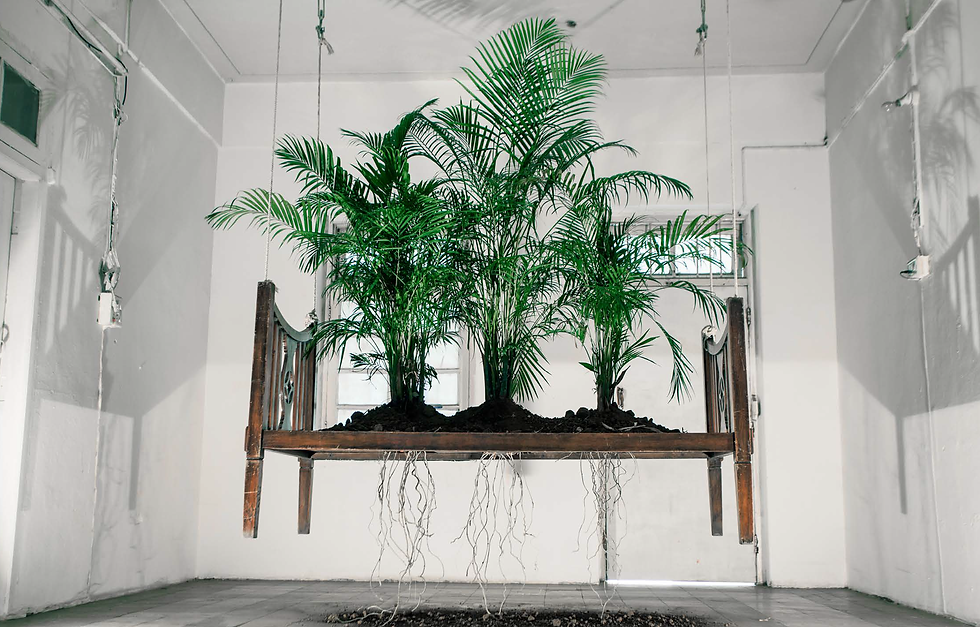
“Bearth” attempts to investigate, discuss and initiate a creative response to our understanding of the social and ecological conditions of Pune, Maharashtra, the Indian subcontinent and our globe in general. The exhibition explores the impact of urbanization, chemical farming and other commercial activities on the landscape and the identity of natural space in Pune, in a collection of objects, sounds, images, seeds, and community practices.
“For all things come from earth, and all things end by becoming earth.” (Xenophanes)
Breathing
Installation, mixed media
Maharashtra is the state having the highest number of farmer suicides due to growing debts and crop failure, which is caused by the exploitation of land in chemical farming.
“Breathing” gives voice to the living quality of earth; a fact that is neglected in present day practices.
Shifted
Installation, recycled materials, plants
As cities are expanding and urbanization, industrialization take place, we reach a point when there is a severe alienation from our natural surroundings. Through the installation a personal attachment is sought to be established with the detached natural space and reality.
Community Seed Bank
Installation, mixed media – community project
Farmers and gardening enthusiasts were invited to collaborate and set up a community seed bank in Pune. The organic materials and seeds of various plants highlight the importance of natural farming and attempt to offer a sustainable solution for present day’s ecological and social hardships. The community seed bank is later managed by a local agricultural organization and serves as a platform for seed exchange.
Lifeforms
Installation, mixed media
Lifeforms is an experimental work connecting art and biology, framing them as constantly changing overlapping realities.
Madhu Das

What allured me of this motel turned to artist residency studio and concomitant institution expands to the idea of social space for cultural exchange. But, this idea of opening space for 'public' negotiates between identity of the public and the private within the subject matter of artworks itself. This space co-existed as perceived attributes of public that carries a layered identity over time and remains a visible site of interplay. I-folding on to this central idea of shared space, my works enter the discussion to examine the practices within the 'identical' space.
The installation of four abandoned door frames from the past is re-constructed as seeming disjuncture from its former framework. In doing so, this work reveals a space for interaction. Without this interaction identity of space doesn't exist on its own. The act of participation here becomes a tool to construct and deconstruct a space.
There's no escape from the dust | Nooshin Rostami
Acrylic and Ink

"There’s no escape for the dust" is a series of abstract paintings. Throughout the process I seek to control the medium by keeping it within the broken geometry of a cube and in the meantime allowing the fluid material to seep through the predefined rigid borderlines, all in an effort to draw an outline of the space between a dichotomy.
Period. Move to the next line
Installation
The last piece I made at TIFA residency as an ending point for an interwoven body of work. This piece is a conversation between two fans one on the ceiling and the other one installed on the floor. The fan on the top spins the one on the bottom which in extension draws a line on the canvas underneath it.
I fell for a building
Video installation
I fell for a building is a performative embodiment of my journey as an expatriate artist traversing exile. Ever since I moved to the US from Iran, I have been defined, or rather confined by my immigration status. At every turn, from my education to career choices, my status has been the dominant factor, restraining me from making life decisions as a member of the society. Every day I feel condemned to pay the price for being born in a distant geography with politics that bear frictions. Evidently pursuing American citizenship, regardless of its uncertain, cumbersome and frustrating bureaucratic process became my top priority and concern to overcome the immigration obstacle, and lessen the burden of the vague classifications that I have been toting, such as “F1 student on a single entry visa”, “O1, Alien with Extraordinary Abilities”, “Resident Alien”, “Pending Status”, and so forth.
I fell for a building is continuation of a previous performance called “Paperwork”, in which I construct a personal narrative of a morphing home, a glimpse into an interwoven past, and a future in the making.
This installation consists of the documentation of my performance at Tifa on April 6th projected inside of a paper cube. The audience can enter the cubical space one at a time to see the video.
Thresholds | Transitions | Priyesh Trivedi

Since space and time collectively exist as a single entity, any enquiries into the nature of space inevitably channels the thought into the nature of time. In a much broader retrospect it only is a valid proposition if this dialogue is in relation to the existential nature of the conscious being experiencing spacetime as a coherent reality. The artist explores the existential relationship and anxieties between the physical reality that we inherit and the inevitable transition to a virtual world that we are heading towards while also trying to answer the questions of how far could the lines between the biological and virtual worlds be blurred if not erased.
The works on display are an expression of this contemplation.
Inner in Internal 1 & 2 | Shimul Saha
Video Installation, 1.6 min
Wood & Print on Paper

Wherever we are, we belong to a space that is static. On the other hand a person is moveable, and is represented by a number. A person is a number and a space is a part of geography. Both of them can’t decline or deny this universal uniqueness. One is moving with a static number and another is lying in a static area. After everything, at the end of the day, both of them live together with their identity. It seems like a DNA, something a person or a place can’t change or remove from their body.
Inner in Internal - 3
Glass, wood and sticker
Pune : Old and the new-The double-edged city | Sheersha Mukherjee
Site specific Installation

The multiple layers of human existence define the composite nature of contemporary cities. A city within a city, home and homelessness, static and transitory culture, the feudal and the modern, the classical and the postmodern jostle with one another in a city. It creates a space for dialogue as well as friction which complicates the question of identity of space within the context of the city.
The textures and contours of architectural spaces, erasures and memories in different sites of the city were etched on my mind. The work depicts my relationship with the city, its spaces and various layers of history and culture. Drawing from old photographs, my prints create another layer of visuality within the space of an old hotel, Shalimar Hotel. The unknown people present in these photographs appearing on the vertical prints become a site for revisiting your past. My insertions of objects from Pune city onto these visuals create another layer where history connects with the contemporary. In addition, my sketchbook becomes another way of interacting with the city and its people.
An Instance Of Object | Utsa Hazarika
Installation

Using mirrors to reflect the projection fills the room with fragments of the original video, breaking the rectangular ‘frame’ through which video is traditionally viewed. Nooshin Rostami’s performance with the dresser deconstructs the physical object, echoing the ways in which mirrors act on the projected video. Breaking the unity of form, of both object and video, allows us to look at their existence as de-objectified instances or occurrences of their scattered parts.
Rites of Passage
Video Installation
The movements of spaces and artists at TIFA.
Press


CONNECT
PLAY
SUPPORT
OPPORTUNITIES