

ARTEL | The Futures Of The Past | 2017
ARTEL
5th February - 5th March 2017
Residency

The Futures of the Past, hopes to engage the participants in the notion of time and its transience, in fate and serendipity, in the process and improvisation that comes from creating works across time and space. It stems from the nearly century-old building that houses the residency, and from the city of Pune itself!
The 10 artists and a critic-in-residence, are from from different parts of India, and the world, including Korea, Taiwan, Turkey, the UK and USA. Each will — during their 4-week residency at the Studios — explore and engage with the space, the city and the notion of time, to culminate in an Open Studios where the works created during the residency will be on public display. In addition each artist will present their past projects, processes and ideas in public presentations.
The Artel -- ‘art’ housed in a ‘hotel’ -- residency was begun in 2016 as a way to draw international visual arts practices into the city of Pune, which has few spaces that forge a deeper connection with the contemporary scene. It is unique in its selection of multidisciplinary artists: they range from installation artists and sculptors, to filmmakers and dancers. With a strong belief in the universality of art and its potential to positively impact society, TIFA Working Studios attempts to create a community oriented space, where innovation in performing, theatre, visual and allied arts are accessible and nurtured.
Discarded and saved Furniture | Mansha Chhatwal
Mesh and Thread

The artist has always been drawn to old, discarded furniture that has already lived several lives. As a response to the homogenized, use and throw objects of today, the artist looks to pay attention, instead, to the unacknowledged relationship with objects from our home that we develop over years, even across generations.
She has thus chosen a selection of old objects from the TIFA archives, and overlays the marks made by time on these objects, with her own work. She casts a thin veil over the object, exploring memory, intimacy, and the passage of change. The thread fiber extends the tactile surfaces of the ageing wood, while the intricate threadwork responds directly to the craftsmanship. Through the slow act of stitching, she mediates the dialogues that occur between object, and artist.
Philosopher’s Wasps | Jagrut Raval
Gold, Wasps, Cyanotypes, wooden pillars

In 1947, a mysterious man named Narad checked into room number 34 in the Hotel Wellsley for one month. He was an elusive Indian explorer, photographer and alchemist who travelled across India in search of the elixir of life. Narad had heard stories of the Hindu mythology about human beings who lived forever. He wanted to be immortal and see time pass through ages and eons in mankind's history on earth. During his time at Hotel Wellesley, Narad was preoccupied with his research about the golden age of India, and he was determined to travel back in time to experience it for himself. He read works of philosophers, scientists, alchemists from both the East and West, who were invested in search of the philosopher’s stone.
One fine evening when he was sitting in his room, he noticed a peculiar behaviour in a wasps nest. Few wasps were expelling gold from their stinger onto a stone, turning it into gold. Narad knew he had stumbled upon the greatest discovery in the history of human existence. Exhilarated by this sudden epiphany, he wished to turn the whole world into gold. He directed the wasps to turn structures, objects, buildings, monuments into gold and thus make them immortal for the time to come. He began with the wall in room 34. Unfortunately amidst the clamour of Independence, Narad’s discovery never came to public attention. He was forever wiped out from History.
Legend says he turned himself into gold at 12 am on 15th August and became an immortal traversing between different ages on Earth. Disappointed at the world he turned to the mountains and it is rumoured that he spends his time traveling between the different stages of human history.
Working Gestures | UBIK
Various Medium

Working Gestures is a series of durational installation that explore the transformation of a material from an active to an archival state of being. The installation comprises of five works: each connected by a common material–Red oxide primer–that dictates the format in which it is displayed in its eventual state. Here the primer acts as a material that redacts and distorts the appearance of the display as a way to preserve its own form.
Groundless | Samantha Harvey
Digital film, projection, gifs, paintings, photographs, speaker

These are the musings of the artist’s first trip to Pune, India. Encapsulated in a single room installation of mixed media, Groundless takes the digital into a physical space and immediately responses to its surrounding environment.
Untitled | Saubiya Chasmawala
Mixed media on paper.
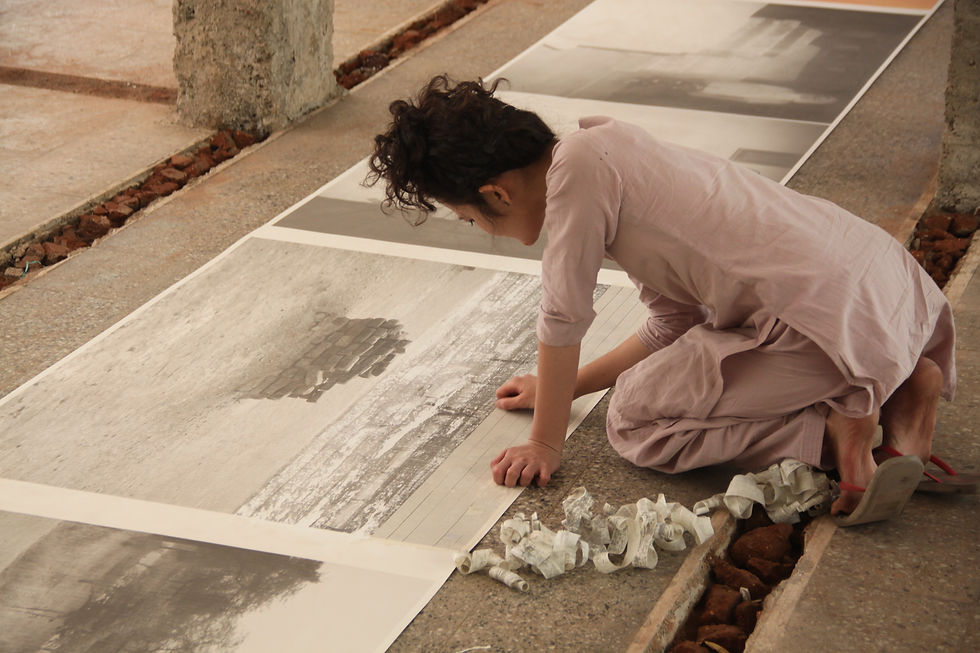
The artist’s family archive comprises of many photographs that are records of visits to various places of religious significance – depicting the graves and tombs of people who have played an important role in carrying forward the lineage, beliefs and history of the community that she was born into.
In this series of works she used these photographs as a starting point to engage with the surface of paper to arrive at a negotiation with the image. The artist has thus intuitively responded to the images and made various interventions through gestures that are suggestive of a space beyond the image itself.
Under Construction | Riya Mandal
Live performance

This is a site specific piece which looks at a space in terms of its elements of broken walls, unused objects and the interaction of labourers within the space.
Performers: Janhavii Pathak, Makarand Pitre, Riya Mandal, Soundscape II, Vishwamitra II
Bug | Krister Olsson
Mixed Media

After a long day spent in the studio staring at the window and the vinyl chaise in front of it, the artist decided that his work in Pune would be about disorientation, exhaustion and dislocation after approximately 25 hours of travel.
The hazy quality of the light coming through the window is reminiscent of noir film, specifically the surrealist noir of DavidCronenberg’s Naked Lunch with its talking cockroach typewriter. The furniture in the hotel thus began to take on anthropomorphic qualities and the chaise in front of the window started to look like an animal…
Missing 1000 Rupees | Jhou-Yu Hsieh
Fabric, Thread

Narendra Modi: “The five hundred and thousand rupee notes hoarded by anti-national and anti-social elements will become just worthless pieces of paper.”
January 1978, the Indian central government demonetized all high denomination bank notes (₹1000, ₹5000 and ₹10,000).
November 2016, Indian Prime Minister Modi announced the presently in use ₹500 and ₹1000 currency notes, which accounted for a total circulation of 86% in the Indian economy, will no longer be legal tender.
Here, the "informal sector" (the “underground economy") and daily wage labor accounts for 90% of non-agricultural labor force, and this policy had a huge impact on common people's lives. The artist arrived in India in early 2017, unable to ignore the current economic condition. With the aid of seiko needlework, she has reproduced the disappearing ₹1000 note.
With special thanks to Varsha Talera
Press


CONNECT
PLAY
SUPPORT
OPPORTUNITIES