

Refracting Rooms
KHOJ
15th February - 1st March 2015
Residency

Refracting Rooms: Khoj International Workshop 2015, by the Good Artist of Pune and hosted by TIFA Working Studios had an exhilarating line-up of twenty Indian and international artists working with diverse mediums, aimed to push the envelope of dominant contemporary art practice within the city.
The Man Who Turned into a Mountain, an Ode to Marat | Amshu Chukki
Site-Specific Installation

The neighbours and the hotel staff of the Wellesley noticed a strange disappearance or a rather strange kind of transmutation that took place in room no. 30 B. The man who had checked into this room had not disappeared but was found transformed into a mountain while he lay in his bathtub. A doctor nearby who specialised in the repairs of a melancholic heart came to examine this strange incident; he inferred a diagnosis that the man was drowned not by love but by the lack of it. He said that it was under the burden of the utopia that he dreamed of and longed to be in. Some people say he was accustomed to sit hour after hour in his bathtub, from the disfiguring skin diseases from which he suffered, dreaming.
He dreamt of the many perfect worlds that he could imagine, worlds of impeccable perfection, worlds instilled with perfect measures of balance, worlds where statues kissed the sky, worlds that were devoid of scabs and rashes. A clean smooth world. He constructed maps of many mysterious worlds, these worlds like dreams here anything imaginable could be dreamed, like what once a young Venetian had said to the Emperor of the Tartars, “Where even the most unexpected dream is a rebus that conceals a desire or its reverse, a fear.
Cities, like dreams, are made of desires and fears, even if the thread of their discourse is a secret, their rules re absurd, their perspectives deceitful, and everything conceals something else.” Where grass fills the mouths of men who sleep in their dreams. The man vanishes.
This Impermanent Imperfect Form Surrendered to the Invisible Energy | C Krishnaswamy
Performance Video

The performance site was a crematorium on the banks of a river, a transformational space where the five elements come together - water, fire, earth, air, and space. Here, we come closer to the invisible energy surrounding us.
Boiled rice engulfs the artist’s breathing form and as he surrenders himself to the invisible energy, beyond the constant questioning of meaning and existence. Through the silence, one must re-enter the disguised form. The performance is a detoxification of the breathing form, purified through a holistic process, thereby liberating our habitually disguised form. A similar process is used for Linga, where one covers a statue of Linga in boiled rice to end the reincarnation cycle.
DockingRoom | Dominic Nurre
UV ink on flex, UV ink on vinyl, task chairs and urinals

A portrait of a young man printed twice, architectural in scaleand mounted back to back dominates and shapes the room. A cutout portrait of another man, also printed twice and back to back, stands as a figure. Two task chairs, with urinals where seats should be, are joined at their plumbing entries and exits. Doubles
and pairs are formed throughout the space, setting a tone of sameness and homogeneity. There are couples in this room. Docking is the process of joining. The name, DockingRoom, simultaneously refers to:
A. a (space) vessel coming to port, and
B. http://en.wikipedia.org/wiki/Docking_(sex)
Both situations reference a giving and taking; goods, ideas, values, intimacy, flesh, etc. A. requires difference while B., sameness. Differences, materials, fluids are imported and exported, blended and swapped, equally, unequally. Maps towards sameness have been drawn.
Dot’s – Dot’s – Dot’s...and Rhythm | Emran Sohel
Mixed Media

My visit to Tambat Ali made me feel a sound; a rhythm that is not being made consciously. I have presented the rhythmic sound in this room with psychic. The sound echoes in the room and envelopes the viewer. They can find the same rhythmic feeling in this room as in Tambat Ali. Tambat Ali sounds like an orchestra in action, as the craftsmen tap, hammer and beat their material rhythmically.
Metaphysics of Presence | Francesca Lalanne
Plaster, wood

The series is a sculptural sketch that aims to analyse theconcept of the “body as a temple”. It also considers the relationship between architecture and the construction of self. Although the body has been coined to be a temple, the practice of entering a temple to obtain a sense of transformation is fascinating and popular.
Presence has been acknowledged in many aspects; sound, light, objects and form, or the absence of it. All are part of the apparatus of the presence. The attempt is to initiate the concept by casting voluntary bodies using materials like wood and plaster. The figurative play of forms allows for the viewers’ own perception of development and presence.
18 MUSTS | Anderu Immaculate Mali
3x3.2m Paper Collage

Partially burnt paper, acrylic paint, and ink Rules have been a part of my life for as long as I can remember.
Be it in the society, at home, or in school, they have been a block to many aspects and discoveries of my human existence. In the 18 MUSTS, I seek to break the boundaries that rules and conditions can subject one to. To create a platform to express and allow the outburst of human emotions in situations where one has been
under oppression. Rooted in the fact that the building will be transformed into an unconventional art space, a wall with partially burnt cash memos of the hotel dating from 2005 to 2012 was built. The memos are a conformance by the clients of the hotel to be under the rules. The receipts are partially burnt as a representation of the past life of the building, and its present restoration to a second life. The wall was then crashed through by a motorbike and later torn to pieces by the audience as a symbolic gesture of breaking the rules.
Eyes Wide Shut | Kartik Sood
Installation

What is inside is outside, what is outside is inside. We already know everything, as we spend more time living, we just remember. All knowledge gained is memory revisited. The work explores the constant shift between the subjective and objective; by imitating the process of blinking one’s eyes, it symbolises the act. With haunting music recorded, it invokes memory. The constant shift of flickering light appeals the dream state. The images on the walls are constantly appearing and disappearing, challenging the clarity of perception.
Best to the Best | Kartzyna Krakowiak
Sound Sculpture

To understand Katarzyna’s work, one needs to release all ideas of one’s understanding of space as only a purely visual dimension. She incorporates sound as a tool to expand the sensory experience of architecture. The work ‘Best to the Best‘ challenges the fundamental concepts of what space and architecture offer. She is directly linking the meaning of the outside and the inside. The project involves the construction crane opposite the site, belonging to a leading city developer to shift its attention to gently nudge the humble, heritage Hotel Wellesley complex as an act to open a dialogue. A purposeful hindrance of a hand-pound mud structure made using traditional building techniques is placed at the entrance of the complex to fill an earlier empty space. Feel free to feel claustrophobic.
Towards a Human Topography | Laurent Pinon
Fabric, rope

This installation is a transversal exploration of boundaries, transitions, relations in which I am looking at the geography of Pune as a city planner, an architect, a visitor, and an artist. Spending time in Pune has been an opportunity to apply this unique point of view to the city and its inhabitants, and to document the results. Our past, present, future, and possible lives are among us. Every change in our life leaves behind a chrysalis; a trace of our previous incarnation. These chrysalises are ephemeral, and soon vanish. The strings that support them are also supported by them; they concretise our invisible connections to one another and to the outside world.
The viewer creates their own experience by shining a light on what they choose to see. The shadows cast on the wall become manifestations of every individual gaze, changing with the movement of the visitors. The variable dimensions of the shadows refer to the allegory of Plato’s cave — after all, isn’t our reality just the exterior projection of what’s in our minds?
Blessing the Earth and Sky: Brick Abhishek & Bridge Abhishek | Minette Lee Mangahas
Multi Media Site-Specific Installation

Brick Abhishek uses grey heavy bricks found on the property. Placed at the base of the stairs, the building’s central channel, they symbolise the foundation on which we stand, and the raw materials of civilisations. Once formed by hand, now formed by a mould machine, they represent the evolution of labour, building, and our changing relationship with the earth. Bridge Abhishek uses an array of soft, translucent saris donated by women of the community to form a bridge; the feminine counterpoint to the brick. Worn by women for ages, in all walks of life, they nod to the labour that conceives, cultivates, and guides growth. Milk, a substance that is derived from the body and nourishes the body, is poured on bricks and bridge as a prayer for this fledgling institution. May it flourish to nurture and be nourished by artists for many years to come.
Medusa | Kumar Prashant
Scrap wood and glass bottles

The mythical Greek figure Medusa was very beautiful and extremely dangerous. Her paradoxical nature is reflected in contemporary society’s tendency to value novelty and artificiality. A luxury lifestyle has a beautiful façade, but what we do not see is its impact on the world. More often than not, it is the luxurious objects we surround ourselves with which threaten our very existence; polluting our lungs and minds. But, it is nearly impossible to separate our attraction to this lifestyle from the destruction it causes.
This attraction to artificial objects is also present in the natural world, when animals swallow plastic, mistaking it for food. Inspired by natural forms, such as ice or rain, the installation questions materiality and consumption. Created using a recycled wooden base and glass, the work is a possible transformation of these waste materials, which gives them a new life.
Skyscape | Rajyashri Goody
Installation

Laws of Manu
Circa 100 BC
From his mouth God
created the Brahman (priest),
from his arms the Kshatriya (ruler),
from his thighs the Vaishya (commoner),
and from his feet the Shudra (servant)
Chapter 1, Verse 51
Skyscape is a tangible interpretation of the Hindu Varna system, where, according to popular belief as well as sacred Hindu texts such as the Manusmriti, it is believed that every caste comes from, and therefore represents, a certain part of the human body.
The position of Dalits, or ex-untouchable community, is below the Shudras, below the feet. For centuries, their caste occupation has been to handle and dispose of all forms of pollutants, be it carcasses, dead bodies, excreta, and all bodily fluids. In fact, they themselves are deemed polluting and impure. Though the practice of untouchability is officially banned in India today, it is still widely practised across the country in various forms, and many attempts by Dalits to break out of the clutches of caste have been suppressed with systemic forms of violence as well as horrific brutality and bloody retaliation, even to basic human rights such as education.
Ironic Democracy | Rucha Kulkarni
Performance at V.R. Shinde Bridge, Pune
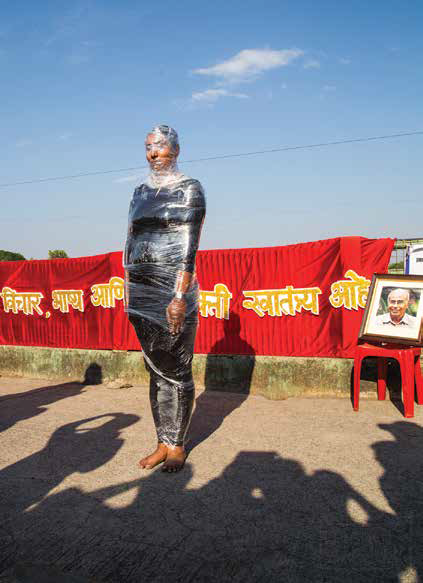
‘Ironic Democracy’ was a performance aimed to put forward the contradictions regarding ‘Freedom of Speech’ in India. This was to show the irony between the ‘freedom’ mentioned in the constitution and the ‘freedom’ allowed by current socio-political institutions.
During this performance, I stood fully wrapped in plastic for 45 minutes, in front of the backdrop, which has golden letters saying, ‘I DO HAVE FREEDOM OF THOUGHT, SPEECH AND EXPRESSION’. This is a satire on the fact that in India, despite being one of the biggest democracies, the fundamental right of freedom of expression is being questioned. The reason I performed on this bridge was also to pay tribute to the social activist, Dr. Narendra Dabholkar, who was shot to death on the 20th of August, 2014.
Farmers’ Haat | Shweta Bhattad
Performance
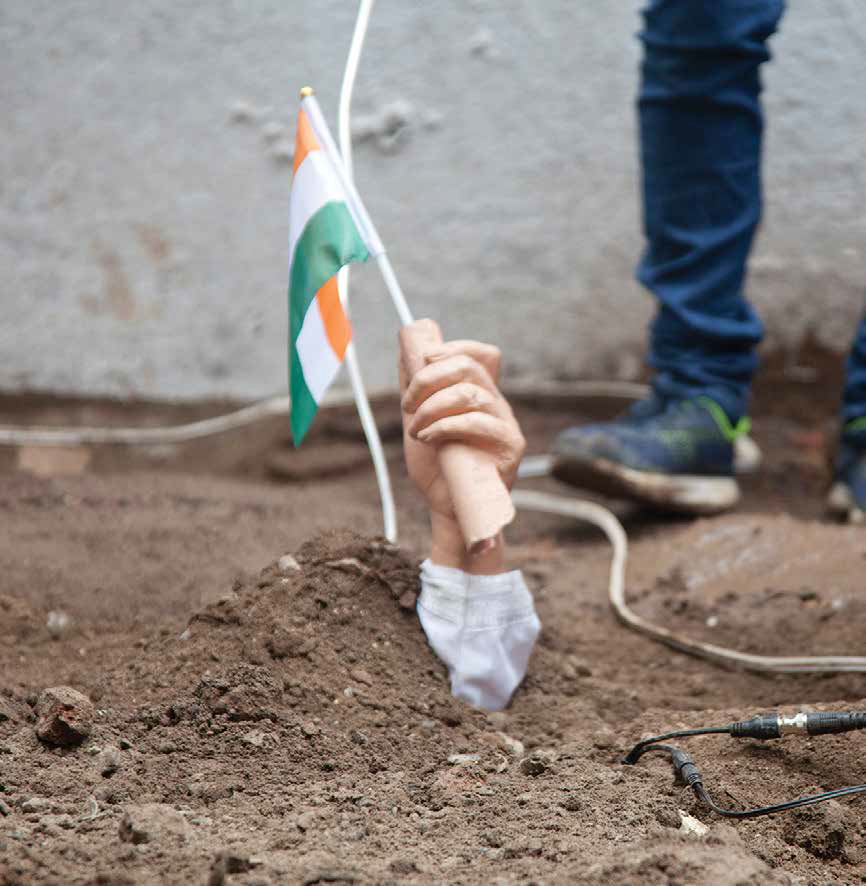
The concept of the Farmers’ Haat comes as a continuation of my engagement with the farmers from India and across the globe. Local farmers have been invited to set up stalls to sell their organic or low residual produce. The aim is to create awareness about the practice and give them the due dignity of being producers of the prime source of human sustenance.
The performance evokes a sense of hope, not by poeticising the current scenario, but as an attempt to focus on the issues and take responsibility as a community. I simply take the form of a medium.
Daughters of Solstice | Shraddha Borawake
A Celestial State of Mind, Duration:21,600 Human Breaths

This project was born from the need to get out of photography and work with the language of light, sound, and text installation only. The venue of the hotel has always inspired me to heavily interact with the corridors, and manifest my imagination through massive transformation of the actual structure. Inspired by my last work made in TIFA, ‘Camera Obscura’, I have used the same process of blocking light at the workshop. This time, in room no.31, I have explored an ongoing food and photography project, ‘Daughters of Solstice’, without the lens. I used ‘channis’ (seives), lights, and darkness to create a sensual experience of a celestial atmosphere. Transforming the entire space into a vacuum of thought and expression, with planetary sounds, ice, and one tiny ring of light entering a blacked-out studio. The Sun, the Moon, and the reigning deities are presented in this experiential work. The illuminated crescents of light share aspects of a particular female energy that has travelled from the Sun to the Moon for the entire duration of the workshop. Inspired by Lalita Maha Tripura Sundari from Shri Vidya, I continue to share knowledge and raise the question of roots, rituals, and cultural identity in the Pune version of ‘Daughters of Solstice’, in March 2015.
Spider and His Spider Web - Stuff They Don’t Want You to Know | Snehal Kulkarni Dutt

The dichotomy in understanding nature has interested me for some time now. By dichotomy, I refer to the two-fold, and at times complex, meanings that appear in my mind while observing my surroundings. In my process, I experiment with the object of interest, its metaphors, and the relation between them. Even though the inferences I make may not be true, they are subject to my mental cognition. These ideas have given me an insight into understanding the world poetically.
The present work is a piece of fiction where there is metaphorical relationship between a spider and its web. Curious about the relation between the phenomenon of nature and the phenomenon of the rational world we live in. I tried to look deeper at the relationship between a spider, which can see various dimensions of an object with its multiple eyes, and its web, which can obscure our vision. This is similar to people who have information but cling to their own social and political position by using power to manipulate and confuse others, preventing them from getting a clear understanding of reality.
On Her Own | Svea Schnider
Dance Performance

Creation | Confinement | Shedding | Cleansing | Death | Self
The female identity is a product of century-long classifications, definitions, and constructs. It has been subjectified and objectified through a range of discourses. Throughout cultural, social, and political history, the male gaze has created a narrative for the female identity, and has defined the female body through dualistic concepts. Archetypes are universal and mythical ideas inscribed on the female identity, ideas of identity that reside in the female body that have been injected into our consciousness by the male gaze. “On Her Own” is a moving dance performance that takes the audience on a journey to explore female identity and witness the creation, confinement, shedding, and an eventual death of the four universal archetypes prescribed on the female body. The performance moves through six different areas of the building, each time exploring a different realm of the codification, categorisation, and impact of confinement given to women throughout cultural, social, and political history. Through a synthesis of choreographed movement, improvisation, sound, paint, diverse props, and other artistic elements, “On Her Own” rewrites the female body by placing the woman as the protagonist in creating her own identity and shedding male- made conceptions of her.
Dancers: Karishma Harlaka, Jhanvi Pathak, Tejasvani Patil, Rajyashree Ramamurthi, Svea Schneider.
Whisky Time Project | Syaiful Aridanto
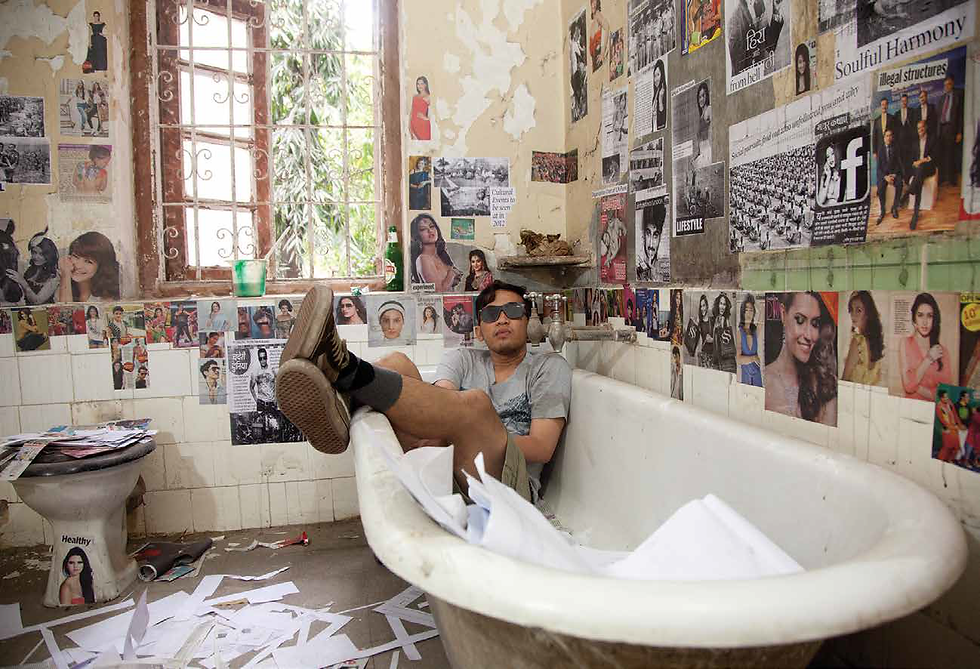
While creating the artwork, I drew similarities between Pune and Jakarta, the busy traffic, and the behaviour of people. I chose a local newspaper bought at the roadside as my material, because I am inspired by the images of the local; the closeness to the community or society, due to cultural events featured. Citizens know what is going on today, and newspapers can provide a different experience for the people who read it, because I think the news in a newspaper is the real culture that exists in the city of Pune. The images exhibit diversity, ranging from advertising beauty, people dying, luxury commodities, celebrity images, housing advertisements, etc. I combine the images randomly with text taken from the newspapers too, creating a nature of teasing and mocking. There is not necessarily any relation between one image and the other. The concept of playing with images and text are applied to me when working. In the process of making the collage, various people came forward. The security guards, hotel employees, and people passing by were curious about my work, and some even interacted with me. The choice of the studio space has helped this interaction. For me, the interaction is more critical than the final work. The most important point of this residency is how artistic activity becomes part of the community and people can join in any artistic activity, such as the security guard who is interested in making a collage, because he saw the familiar images in his life. It’s a kind of participatory art.
After the interaction and response, I then concluded that in the end the physical work that I do is not so important, but the crucial aspect is when I get the impact during the making of the work, where people are smiling and commenting on images and text. They certainly have the reference and reading newspapers that contain news daily and they consume every day, until finally they are interested in participating and making a collage too. Images of the newspaper are easily recognisable and easy to digest, because each morning, they get to see or read newspapers.
I deliberately chose an existing workspace that ordinary people walk through, back and forth, because I wanted no interaction with the person who passed it to get a response or input on my final work. My observation through this process is that the artwork should have a relationship with their daily lives.
Tambat Ali / 2015 | Szu-Han Chen
Video

Following the steps of a little boy from the coppersmith (tambat) community, walking through the alleys, the video portrays the life of the vicinity. The video brings focus to a disappearing industry and the beautiful sound created by the artisans. The video was shown to the people of Tambat Ali in a local temple.
Indian Dabbling in Basic Shapes in the Age of Transformer 3 | Vaibhav Raj Shah

Landscape painting was my earliest fascination. It was never my intention to get drawn into debates over beauty, its objectivity, or eternal qualities. It began with putting paint to canvas superficially, creating ideal portraits of Mumbai, and elevating its spaces from the everyday squalor of an overpopulated city bursting at its seams. I started to see this macro example of a city and its workings and internalising it.
I wanted to paint pretty pictures of these landscapes, but what I encountered was both a failure of the medium to capture the qualities in front of me, and more importantly a failure of the scene to meet some prescribed ideals of beauty. I found myself perpetually “correcting” the city within my work. And so I veered
into a different manner of description. In the photo and video works entitled “Superficial”, I started with these inescapable gaps and failures, and simply assessed various sites around the city, giving them scores out of hundred. These “marks” (refer to art work) became my preferred use of the landscape mode. “Marks” should be understood in the double sense of the word: (1) the act of mark-making or inscription, and (2) assessing
and objectifying in the quest for idealism. To document these interventions instantaneously, paint on a canvas proved insufficient. Paint only made its way to the pavement, or the bench, or someone else’s graffiti, and I clicked a photo or took a video. This eventually seemed to be the only way I saw myself possibly making landscape painting, and indeed the only remaining possibility of what landscape painting could be.


CONNECT
PLAY
SUPPORT
OPPORTUNITIES